

Real world
use cases
AI where the work is repeatable, knowledge matters, and outputs need to be more consistent
Discover examples of real world custom AI applications built to solve meaningful, complex problems.
Lead Enrichment
Outcomes
- Richer CRM records with more useful prospect context
- Clearer visibility into fit, motivations, and buying signals
- More consistent qualification across the pipeline
- Better alignment between prospect scoring and your actual offer
- Faster preparation for outreach and follow-up
- More relevant personalised messaging at scale
- Cleaner pass-back into the CRM for downstream action
The problem solved
Lead Enrichment solves the problem of incomplete CRM records, inconsistent lead qualification, and too much manual research before a sales team can act. In most businesses, prospect data is patchy, buying signals are missed, and suitability is judged differently by different people.
That leads to weak prioritisation, generic outreach, and time spent chasing prospects that are not a strong fit. For consultants, service providers, and SMEs, it creates a more reliable way to understand who is worth pursuing and why.
How it works
Lead Enrichment loads prospect records from the CRM and performs bulk research to build out a richer picture of each account. It compiles firmographic, technographic, and behavioural data, predicts likely motivations, and extracts buying signals. It then compares each prospect against the organisation’s products and services using the central knowledge base, producing both a suitability score and a written suitability assessment.
It also generates a detailed output field containing CRM-ready notes, account intelligence, segmentation tags, outreach copy, personalised messaging, and follow-up sequences, then passes that enriched data back into the CRM for qualification, lead scoring, or sales outreach.
Magic Studio
Outcomes
- Faster creation of imagery across multiple fabric variants
- Less manual editing and less need for repeated shoots
- More consistent presentation across product options
- Clean cut-out assets ready for web use
- Hyper-realistic roomset images for merchandising and product pages
- Better content velocity for R&D projects
The problem solved
Magic Studio solves the problem of producing high-quality product imagery across multiple sofa variants without repeated photography, slow manual editing, or inconsistent outputs. For furniture and ecommerce teams, creating cut-outs and lifestyle visuals for every fabric option can be time-consuming and expensive.
This application makes that process far more scalable by generating new variants from an existing sofa photo while keeping the product itself consistent.
How it works
Magic Studio takes a sofa photo, applies multiple fabric options without changing the shape or product details, and outputs two types of finished assets for each variant: clean web cut-outs and studio-quality hyper-realistic lifestyle images.
This creates a repeatable workflow from one source image to multiple ecommerce-ready visuals.
Complaints Analyst
Outcomes
- Faster review of complaint cases and service files
- More consistent answers grounded in source material
- Structured evidence packs to support investigation and response
- Improved response quality in governance-sensitive environments
- Stronger auditability and audit readiness
- Less manual effort when working across recordings, files, and case evidence
- Greater legislative compliance
The problem solved
For consultants, service providers, and SMEs handling complaints or service issues, Complaints Analyst solves the problem of slow, manual case review. Teams often have to work through voice recordings, customer service files, and supporting records by hand, then piece together what happened and justify their conclusions.
That creates inconsistency, slows response times, and makes it harder to show a clear audit trail.
How it works
Complaints Analyst ingests voice recordings and customer service files, then allows users to ask questions against that source material. It returns answers backed by a structured evidence pack, so the output is tied to the underlying case rather than general interpretation.
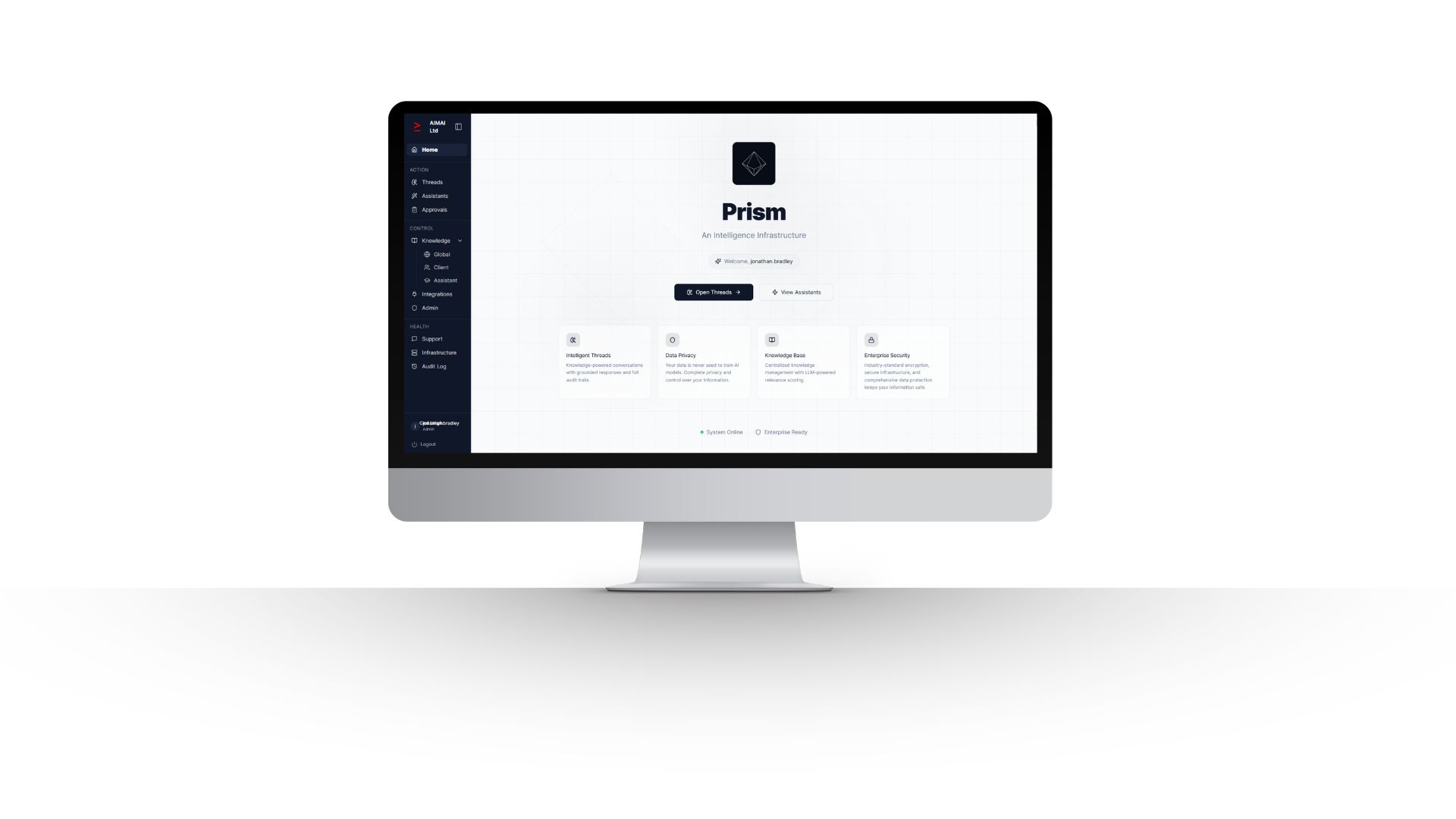
Inside PRISM, that kind of workflow sits within a governed environment, which helps teams operate with clearer controls, stronger consistency, and better oversight.
Machine Support
Outcomes
- Reduced downtime caused by slow troubleshooting
- Faster access to operating and fault-finding guidance
- Less dependence on senior or specialist staff for routine support
- Quicker onboarding for new operators
- More consistent use of approved machine knowledge
- Easier navigation of complex manuals and diagrams
The problem solved
Machine support solves the problem of critical operational knowledge being buried in manuals, diagrams, and the heads of experienced staff. When operators need to programme, run, or troubleshoot complex machinery, finding the right answer quickly can be slow and inconsistent.
That creates avoidable downtime, makes onboarding harder, and increases reliance on a small number of people who know the equipment best.
How it works
The applicationingests manuals and technical diagrams, turns them into a searchable knowledge base, and allows operators to ask questions in natural language. Instead of manually working through documentation, teams can use conversational support to find the right operating guidance, troubleshooting steps, and technical information more quickly.
In a PRISM environment, this kind of knowledge can sit inside a governed platform, so support is grounded in structured business knowledge rather than ad hoc searching.
Finance Analyst
Outcomes
- Faster production of management information packs
- Less manual effort in turning trial balance data into reporting outputs
- More consistent dashboards, commentary, and summary packs
- Better month-end insight cadence
- Clearer reporting for internal stakeholders or clients
- Stronger standardisation in how financial performance is explained
- Better day-to-day support
The problem solved
Finance Analyst solves the problem of slow, manual reporting workflows that depend too heavily on individual effort. Teams often spend too much time turning raw financial data into something decision-makers can actually use, pulling together dashboards, summary packs, and written commentary by hand.
That creates inconsistency in reporting, slows down month-end insight, and makes it harder to maintain a reliable cadence of analysis across clients or internal stakeholders.
How it works
This application ingests raw trial balance data and turns it into a more usable reporting output. It can support on-demand insight requests, generate an MI dashboard, and produce a full management information pack with written commentary. Within PRISM, that kind of workflow can sit inside a governed environment, connect to relevant systems and data sources, and be delivered as a repeatable custom application rather than a one-off task.
The result is a more structured reporting process, with outputs that are easier to review, share, and act on.
Why we make bespoke AI application
Our systems are structured around workflows, not tools, so they support the work your team already does, with the right knowledge, controls, and context built in.
They connect with your business data and existing systems, helping teams work faster, more consistently, and with greater confidence.
This is not about replacing people. It is about improving how work gets done, reducing friction, and making better use of the knowledge already inside the business.
We start with high-value workflows, embed intelligence where it matters, and improve it continuously over time.